Research
The Uchida Lab conducts research on quantum transport, such as anomalous Hall response, quantum Hall states, and exotic superconductivity, with producing epitaxial thin films and artificial heterostructures of topological and correlated materials. The following are some of the latest core research projects in our group. Please get in contact with Uchida for details.
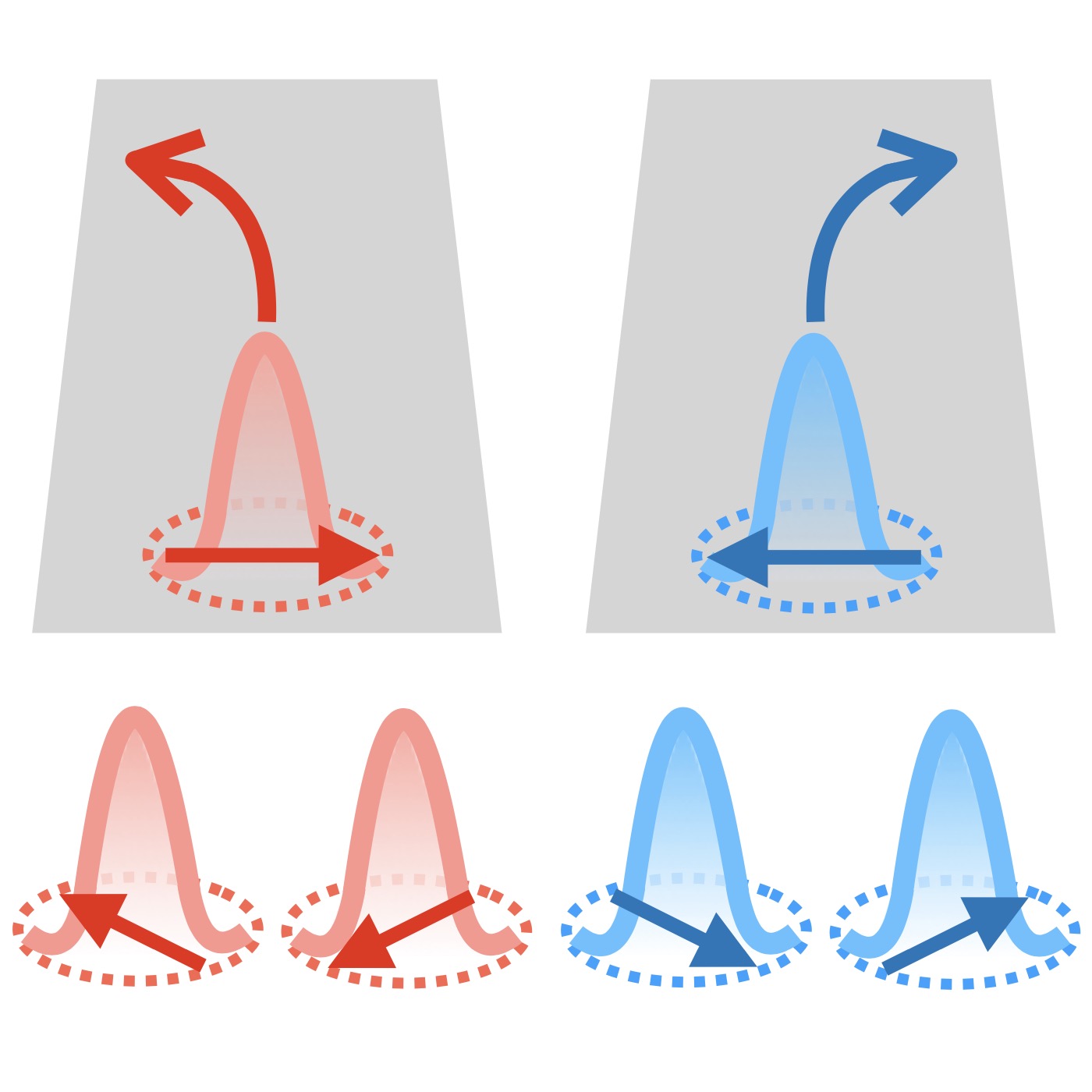
The Hall effect has traditionally been understood as a transport response proportional to the out-of-plane component of a magnetic field or magnetization, on the basis of a diagonal and linear response paradigm. By contrast, we have recently observed an anomalous Hall effect induced by an in-plane magnetic field. In this effect, a quantum geometric quantity known as orbital magnetization emerges through spin-orbit coupling, independently of spin magnetization, thereby realizing a novel off-diagonal transport response between the magnetic field and the Hall resistivity vector. Motivated by this discovery of the in-plane anomalous Hall effect, we aim to develop new off-diagonal transport responses and achieve their systematic understanding through symmetry-based materials exploration and quantitative experimental investigations.
Novel Off-Diagonal Transport Responses
- In-plane anomalous Hall effect associated with orbital magnetization: Measurements of low-carrier density films of a magnetic Weyl semimetal
Physical Review Letters 133, 236602 (2024). Selected for Editors’ Suggestion - Difference in the in-plane anomalous Hall response in thin films of the Zintl compound EuA2Sb2 (A = Zn, Cd)
Physical Review B 111, L241106 (2025). - Spontaneous In-Plane Anomalous Hall Response Observed in a Ferromagnetic Oxide
Advanced Materials 37, e02624 (2025). Selected for Hot Topic: Magnetic Materials
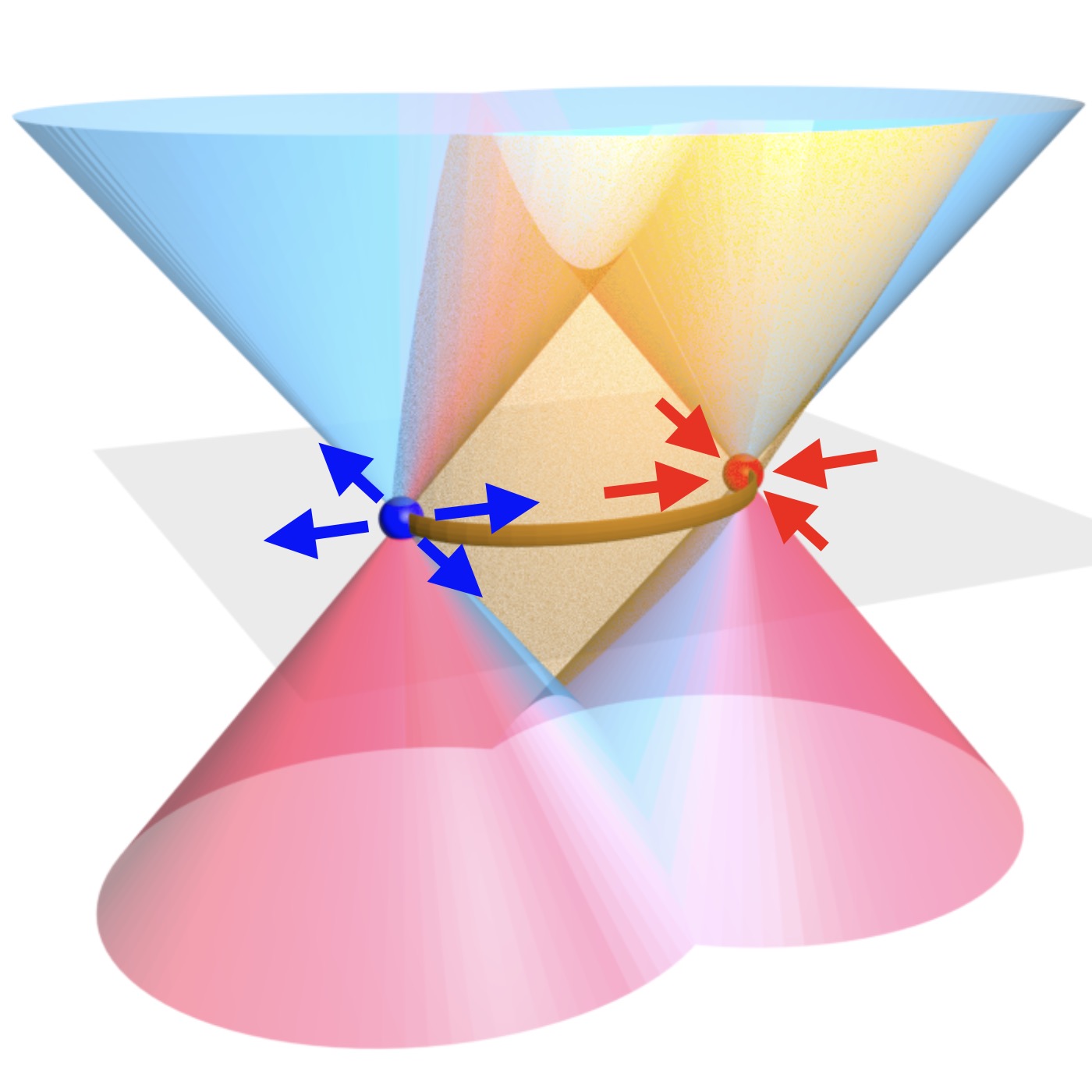
In semimetals characterized by small Fermi surfaces, transport properties are expected to be predominantly governed by quantum geometric effects, exemplified by Berry curvature. The successful growth of high-quality thin films of magnetic topological Weyl semimetals has enabled experimental clarification that such quantum geometric effects appear not only in the Hall response but also in diverse magnetotransport phenomena, including magnetoresistance. Furthermore, it has been recognized that quantum geometric effects can be systematically examined even in nonmagnetic semimetals by focusing on transport components that vary with magnetic field direction. Through these studies, we are pursuing the development of a comprehensive understanding of novel magnetic transport responses governed by quantum geometry.
Magnetotransport governed by quantum geometry
- Maximizing intrinsic anomalous Hall effect by controlling the Fermi level in simple Weyl semimetal films
Physical Review B 105, L201101 (2022). - Berry curvature derived negative magnetoconductivity observed in type-II magnetic Weyl semimetal films
Physical Review B 109, L121108 (2024). - Anomalous Hall Effect in the Dirac Semimetal Cd3As2 Probed by In-Plane Magnetic Field
Physical Review Letters 135, 106603 (2025).
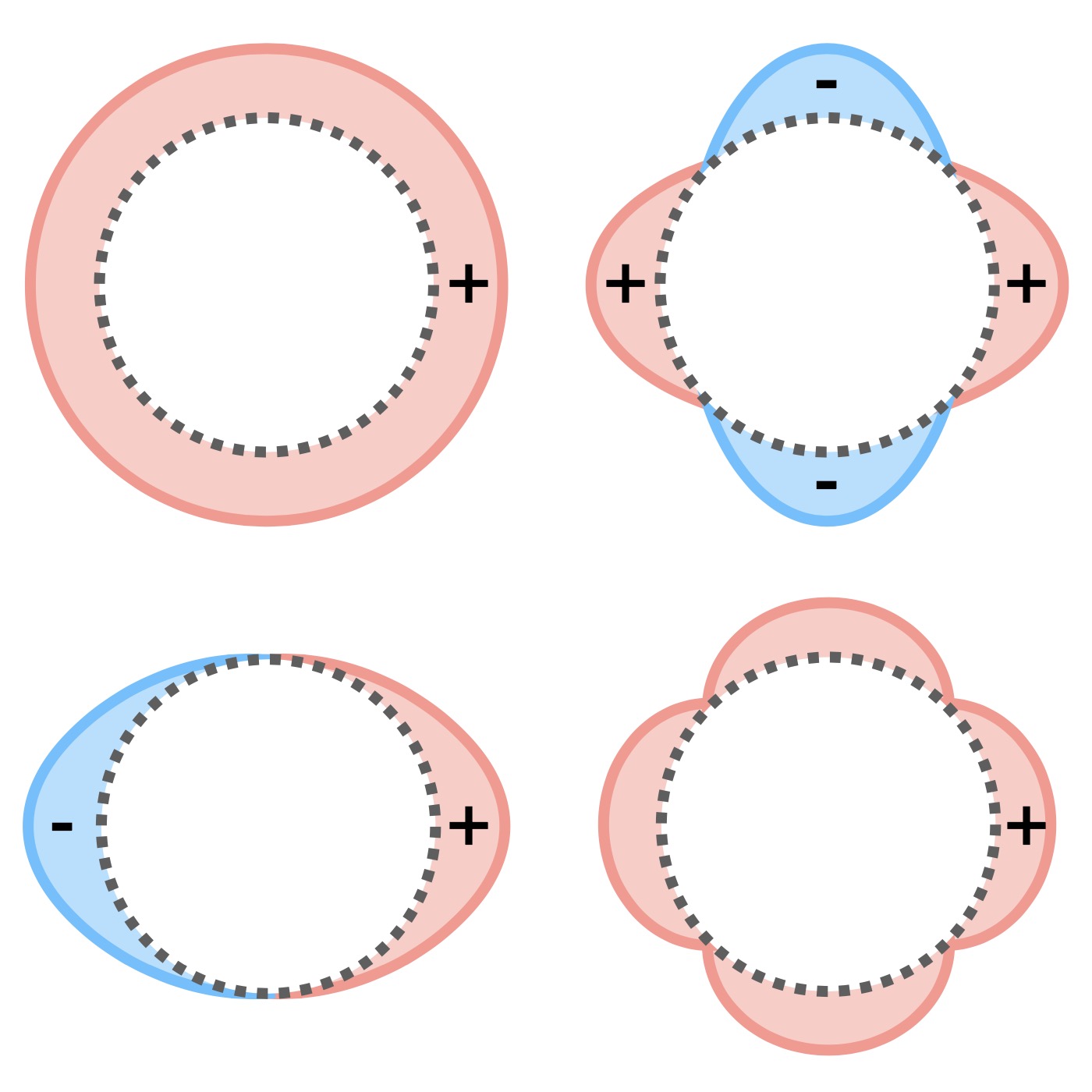
Even for materials that behave as ordinary metals or insulators in bulk crystal form, superconductivity can emerge in thin-film form, enabled by epitaxial strain or carrier doping from the substrate. A rutile-type ruthenium oxide is among the materials in which superconductivity has recently been discovered through such thin-film engineering, and this material has attracted growing interest also from the viewpoints of magnetic ordering and spintronic functionality. Giant epitaxial strain is expected to significantly modify electronic and phonon band structures, and with examining these strain-induced changes, we are advancing studies of superconducting pairing symmetry.
Superconductivity by thin-film engineering
- Superconductivity in uniquely strained RuO2 films
Physical Review Letters 125, 147001 (2020). Selected for Editors’ Suggestion, Featured in Physics - Strain-modulated anisotropic electronic structure in superconducting RuO2 films
Physical Review Materials 6, 084802 (2022).
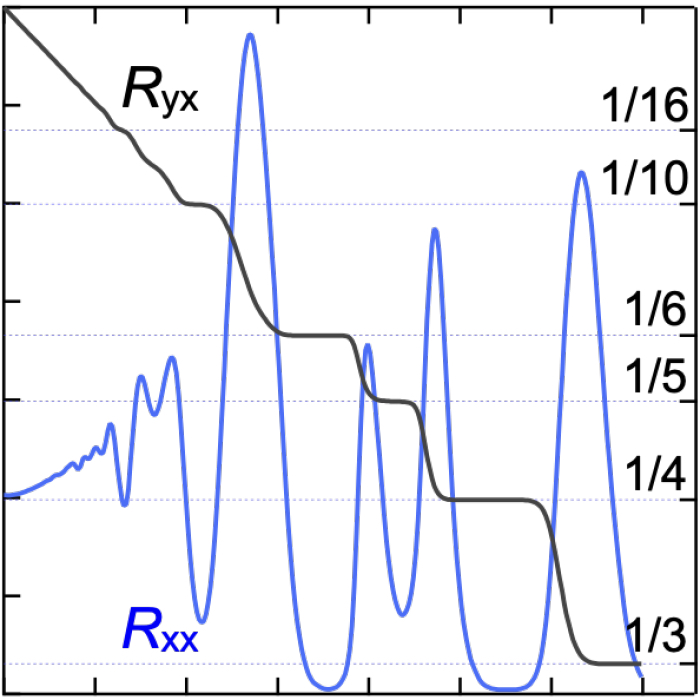
Various quantum transport phenomena have been proposed in topological Dirac semimetal, which corresponds to the parent phase of topological materials with topologically non-trivial electronic structures. While theoretical research has taken the lead in this field, successful fabrication of extremely high-quality thin films of cadmium arsenide, an ideal topological Dirac semimetal, enables us to study novel transport states originating in the three-dimensional Dirac dispersions. We elucidate quantum transport represented by quantum Hall effect, by performing control experiments with film techniques such as electric field effect and chemical substitution.
Quantum Hall in topological semimetal
- Quantum Hall states observed in thin films of Dirac semimetal Cd3As2
Nature Communications 8, 2274 (2017). Selected for Editors' Highlights - Gate-tuned quantum Hall states in Dirac semimetal (Cd1−xZnx)3As2
Science Advances 4, eaar5668 (2018). - Ferromagnetic state above room temperature in a proximitized topological Dirac semimetal
Physical Review B 100, 245148 (2019). - Enhancement of spin-orbit coupling in Dirac semimetal Cd3As2 films by Sb-doping
Physical Review B 103, 045109 (2021).
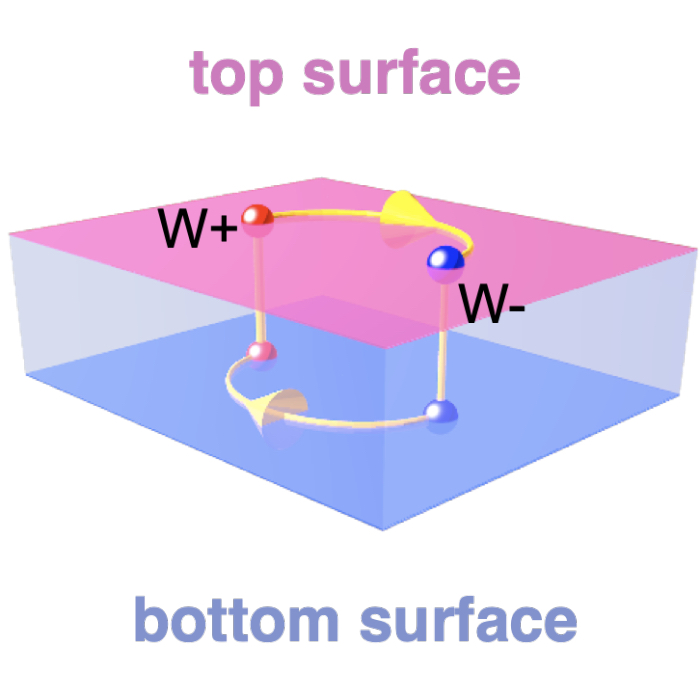
Topological semimetal is predicted to form a characteristic bulk electronic state called chiral zero mode under magnetic fields and exhibit unprecedented conduction composed of the bulk and surface states connected via Weyl points. In fact, conduction of the surface sate and its quantization have been observed in our high-quality cadmium arsenide films, suggesting the possibility that quantum Hall conduction normally appearing in two-dimensional systems can be extended into three-dimensional systems, where the top and bottom surfaces are connected by the chiral zero mode. We conduct research with the aim of developing a new quantum transport theory based on the chiral zero mode.
Chiral zero mode transport
- Quantized surface transport in topological Dirac semimetal films
Nature Communications 10, 2564 (2019). - Molecular beam epitaxy of three-dimensionally thick Dirac semimetal Cd3As2 films
APL Materials 7, 071109 (2019). Selected for Featured Article - Intrinsic coupling between spatially-separated surface Fermi-arcs in Weyl orbit quantum Hall states
Nature Communications 12, 2572 (2021). - Edge and Bulk States in Weyl-Orbit Quantum Hall Effect as Studied by Corbino Measurements
Journal of the Physical Society of Japan 93, 023706 (2024).
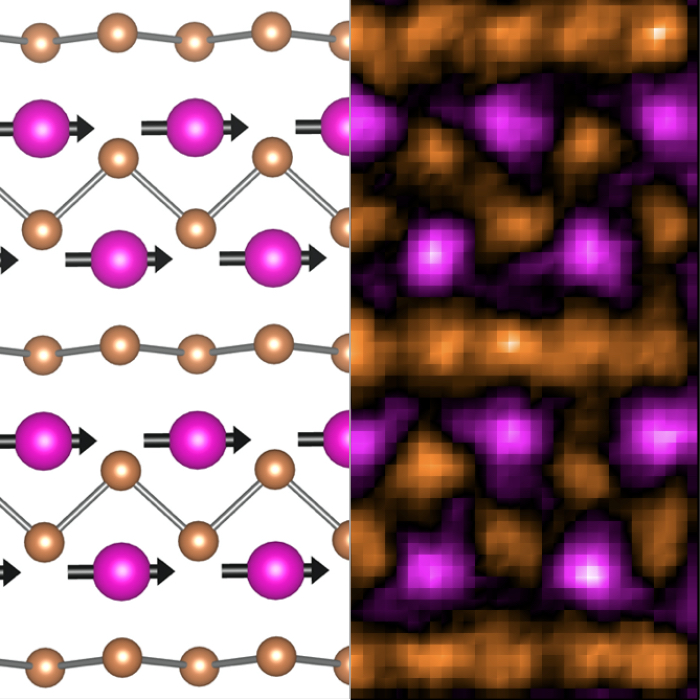
Magnetic topological materials, where magnetic order gives rise to topological electronic states, have the potential to host novel magnetic topological phases through systematic control of their ordered states and symmetries. Understanding these phases critically relies on investigations of magnetic transport phenomena in thin films, which allow flexible tuning of both magnetic order and carrier concentration. Moreover, epitaxial stabilization using suitable substrates allows the synthesis of topological materials that do not exist in bulk crystals. Through the use of these thin-film approaches, we are advancing the exploration of new magnetic topological materials and the clarification of their magnetic transport states.
Novel magnetic topological materials
- Quantum transport observed in films of the magnetic topological semimetal EuSb2
Physical Review B 103, 165144 (2021). - Molecular beam deposition of a new layered pnictide with distorted Sb square nets
APL Materials 9, 051107 (2021). Selected for Featured Article, Featured in Scilight - Above-ordering-temperature large anomalous Hall effect in a triangular-lattice magnetic semiconductor
Science Advances 7, eabl5381 (2021). - Intrinsic insulating transport characteristics in low-carrier density EuCd2As2 films
Applied Physics Letters 124, 023103 (2024). - Topological Hall effect enhanced at magnetic transition fields in a frustrated magnet EuCd2
Physical Review B 110, 035159 (2024).
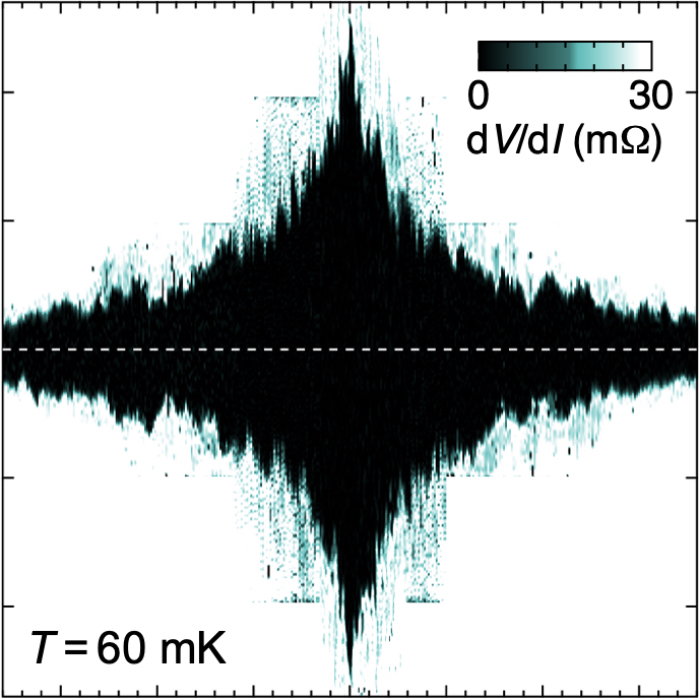
Exotic superconductors with unconventional pairing symmetries, such as topological superconductors hosting Majorana quasiparticles, represent one of the most fascinating research subjects in condensed matter physics. However, their low superconducting transition temperatures and extreme sensitivity to disorder have made thin-film junction studies far more challenging than traditional bulk probes such as specific heat and nuclear magnetic resonance. Layered perovskite ruthenates are representative materials whose superconducting symmetry has yet to be conclusively determined, and phase-sensitive junction experiments are considered crucial for resolving this issue. By advancing oxide molecular beam epitaxy growth techniques, we have, for the first time worldwide, succeeded in fabricating superconducting thin films previously thought to be impossible, and are now addressing the determination of superconducting symmetry through thin-film junction-based studies.
Exotic superconductor films and junctions
- Molecular beam epitaxy growth of superconducting Sr2RuO4 films
APL Materials 5, 106108 (2017). - Anomalous enhancement of upper critical field in Sr2RuO4 thin films
Physical Review B 99, 161111(R) (2019). - Characterization of Sr2RuO4 Josephson junctions made of epitaxial films
Physical Review B 101, 035107 (2020).
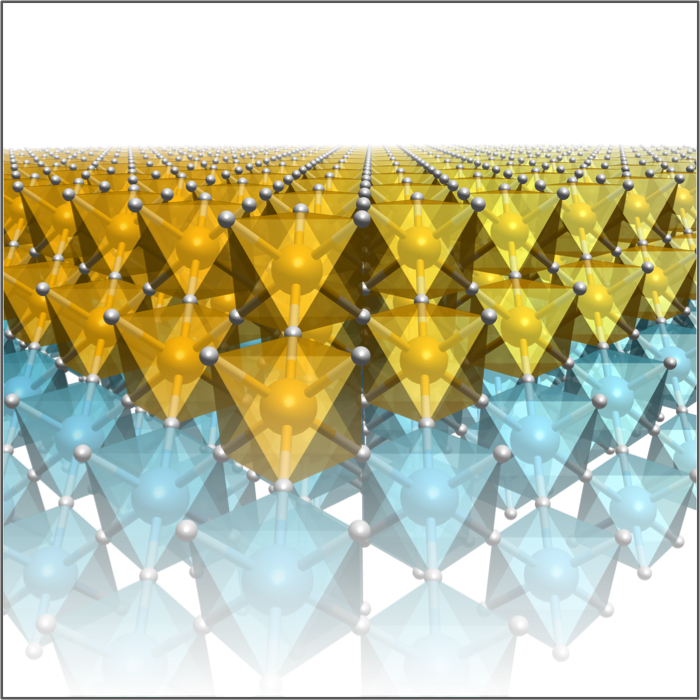
Correlated topological phases driven by the interplay between electron correlations and spin-orbit coupling represent a particularly promising frontier in condensed matter physics. Although a wide variety of fascinating topological phases have been theoretically proposed for iridium and ruthenium oxides with strong spin-orbit coupling, experimental verification and understanding remain limited. Meanwhile, oxide molecular beam epitaxy growth techniques targeting high-melting-point materials such as iridium and ruthenium have achieved significant advances in recent years. On the basis of these techniques, we design and fabricate high-quality epitaxial thin films and artificial heterostructures of strongly correlated oxides, and seek to deepen the understanding of correlated topological phases through high-precision quantum transport measurements.
Quantum transport in correlated topological phases
- Topological Properties and Functionalities in Oxide Thin Films and Interfaces
Journal of Physics D: Applied Physics 51, 143001 (2018). - Ferromagnetic state with large magnetic moments realized in epitaxially strained Sr3Ru2O7 films
Physical Review B 109, L121113 (2024). - Unconventional two-dimensional quantum oscillations in three-dimensional thick SrRuO3 films
Applied Physics Letters 125, 113105 (2024).
Affiliation